Frozen Pipe Repair in Middlesex County, MA

Shut the Main First, Then Call

If water is coming out of a pipe right now, stop reading and go turn off your main shut-off valve. Everything else waits. Opus handles frozen and burst pipes across Middlesex County and the Merrimack Valley, answered around the clock out of North Billerica. It’s the busiest few weeks of our year, and the one job on our plumbing services list that an afternoon’s work in October can prevent outright.

Request Ticket
How Can We Help?
Customer Info
Who is this for?
Only used to confirm your request.
Customer Info
Your email
Only used to confirm your request.
Customer Info
Your phone or mobile number
Only used to confirm your request.
Visit Details
Where should the team go?
Final Note
Anything we should know?
Loading Form

If a Pipe Just Burst, Do This First

What to Do If a Pipe Bursts

Shut the main.

Usually in the basement where the supply enters, often near the meter. Turn it clockwise until it stops. If you’ve never found yours, finding it now is the single most useful two minutes you’ll spend in this house.

Stay away from water near electrics.

If it’s running near a panel, outlets or the boiler, don’t wade in. Cut power at the panel only if you can reach it dry and safely. If you can’t, leave it and say so when you call.

Open the taps.

With the main off, open cold taps at the lowest point in the house to drain what’s still in the pipes. Less water in the system is less water on your floor.

Call, and say where it's coming from.

Which floor, which room, whether it’s still running with the main off. That tells us what’s on the van before we leave. This is 24/7 emergency plumbing, and a burst at two in the morning is exactly the call Rick takes.

SUBMIT A FORM & REACH OUT

Where Do Pipes Freeze First?

Frozen Water Pipes in Older Homes

It’s always the same handful of places, and older houses around here have more of them than newer ones.

Inside exterior walls.

The pipe runs through an outside wall with insulation behind it rather than in front of it. Common in houses plumbed before anybody thought about it, and invisible until it fails.

Unheated crawlspaces and basements.

Anywhere below the living space that nobody heats, particularly where a vent or hatch has been left open since autumn.

Garages and attics.

A supply line crossing a garage ceiling or an attic to reach a bathroom above is sitting in outside air with a wall between it and the heat.

Cantilevered floors and overhangs.

A bathroom or kitchen that projects past the foundation has cold air underneath it on three sides. These freeze early and surprise people.

Outdoor spigots.

The most common of the lot. A valve sitting in an outside wall with water behind it, and usually a hose still attached.

A pipe that freezes once will freeze again. The conditions that did it are structural rather than bad luck, so fixing the split without addressing the reason just books next winter’s appointment.

The Ice Doesn't Split the Pipe

Why Frozen Pipes Burst

This is the part most people have backwards, and it explains why the damage rarely appears where the ice is.


Water expands as it freezes, which is where the story usually stops. But the ice plug itself doesn’t burst a copper line by pushing outward.


What bursts it is the pressure in front of the plug. As ice builds, it pushes water along the pipe toward the closed faucet at the end of the run. That trapped column of water has nowhere to go, pressure climbs in the section between the ice and the tap, and the pipe gives way there. Which means the split is often several feet downstream of the frozen part.


Two things follow from that. Opening a faucet on a frozen line relieves the pressure and can prevent the burst entirely. And a pipe that froze may already be split without anyone knowing, because nothing leaks while the ice is still holding it shut. The water arrives at the thaw.


So if a line froze and you thawed it yourself, keep an eye on that area for a day or two. Water showing up somewhere afterwards with no obvious source is leak detection territory.


Never Put a Torch on a Frozen Pipe

How to Thaw Frozen Pipes Safely

Say this one plainly, because every winter somebody tries it and some of them lose the house. An open flame on a frozen pipe sets fire to the framing and insulation around it, and it can flash steam inside the pipe hard enough to rupture it. No torches, no propane heaters aimed at joists.

Open the faucet that the pipe feeds first.

Before applying any heat at all. That gives melting water somewhere to go and relieves the pressure that does the actual damage.

Work from the faucet end backwards.

Heat the section nearest the open tap and move along toward the frozen area. Warming the middle of a plug first traps meltwater between two blocks of ice, which is how you turn a frozen pipe into a burst one.

Use gentle, steady heat.

A hair dryer, a heat gun on low, warm towels, or a space heater in the room with the cabinet doors open. Slow is the point. If it’s taking a while, that’s the method working rather than failing.
Where we come in is the pipe you can’t reach: inside a wall, under a floor, or in a section you’d have to open up to get at. We’ll tell you honestly whether it’s worth opening that wall or whether the sensible move is warming the space and waiting.

How to Prevent Frozen Pipes

Pipe Insulation and Outdoor Spigot Winterization

Almost all of this is an autumn afternoon, and it costs a fraction of one burst.


Disconnect every hose. It’s the single most common cause of a split outdoor line. Water trapped against the valve freezes, cracks the pipe behind it, and nobody finds out until May. Shut the interior valve feeding that spigot, then open the spigot itself to drain the barrel. If yours has already split it needs replacing rather than repairing, and that’s fixture repairs.


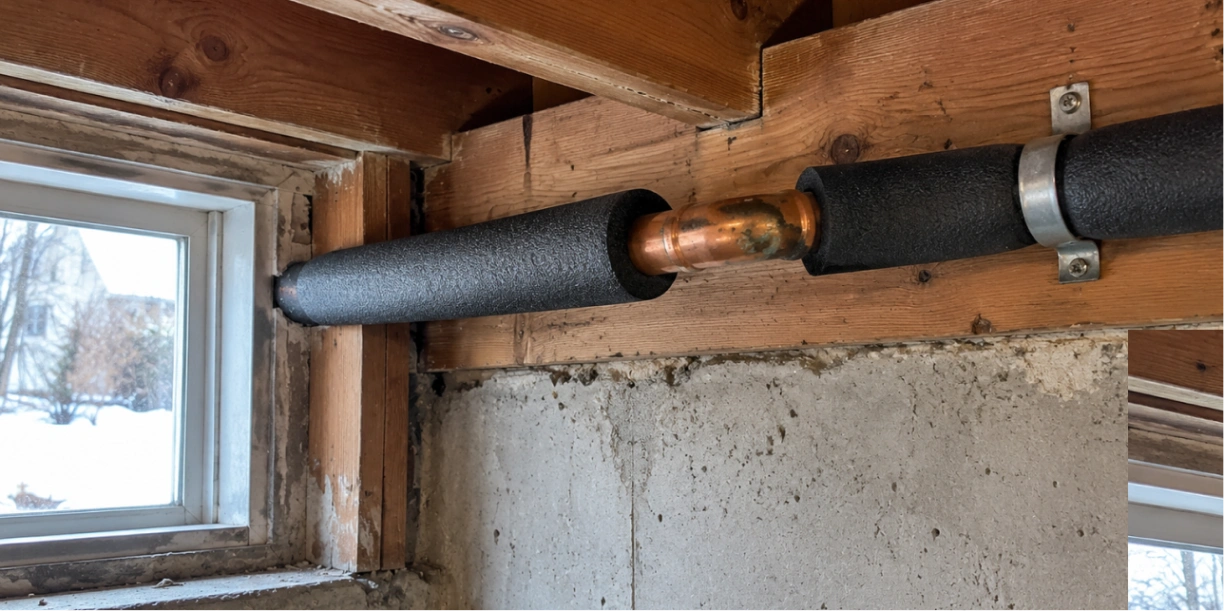
Insulate the pipes in unheated space, and seal the air leaks near them. Cold air getting to a pipe is what freezes it, so a gap around a rim joist or a sill plate does more damage than a missing sleeve.

Keep the heat on and not too low.

55 degrees is the usual floor, including in rooms you don’t use and in a house you’re leaving for a week. Open cabinet doors under sinks on exterior walls during a hard freeze so room air reaches the pipes.

Let a tap drip in a real cold snap.

Moving water is much harder to freeze, and a slow drip on the fixture furthest from the supply costs almost nothing over a few nights.

And check the sump discharge.

A frozen discharge line leaves the pump running against a closed pipe, which is how sump pumps end up dying in January rather than during the storm everyone expects.

A Cold House Is the Real Cause

Heat Loss, Boilers and Empty Houses

Pipes freeze because the space around them got cold. Everything else follows from that.

The worst version is heating failure.

A boiler that quits overnight in January takes the house down with it, and the frozen pipes are the second problem rather than the first. That’s why a no-heat call gets treated as urgent whatever the hour, and why boiler service and repair is worth booking in September rather than discovering in February.

The next worst is an empty house.

Second homes, a property between tenants, or a family away for two weeks over the holidays. Heat turned down to save money, nobody in the building, and nothing noticed until water has been running for days. If you’re leaving a house empty in winter, leave the heat at 55, shut the main, and have somebody look in.

And the quiet one is heat that never reaches part of the house.

A cold room with a radiator that stopped working is a warning about the pipes in that wall. Most of the housing across our service areas is old enough to have pipes running through outside walls.

The Call-It-Straight Standard

We Do Only the Work You Approved

A burst pipe at two in the morning is the easiest situation in this trade to take advantage of. You’re standing in water, you’re not in a position to get a second opinion, and whatever gets recommended sounds reasonable. We tell you what we see and what it costs if it fails, then do only what you approved. If the thaw is the job, the thaw is the job. If we think the run that froze will freeze again and want to say so, you’ll hear it as information rather than as pressure, and you can deal with it in April. Ricky said this himself, before anybody suggested it as a selling point: point out the problem and the risk, ask what you want to do, and attend to what you were called for. That holds at two in the morning, which is the only time it really counts.

Our Customer Feedback

Questions Billerica Homeowners Ask Us

“Clear answers. One written price. You decide before we start.”
Ricky Greene

Owner & Master Plumber

What do I do if a pipe bursts in my house?
Shut the main valve first, which is usually in the basement near where the supply enters. Then open cold taps at the lowest point to drain the system. Stay clear of any water near the electrical panel or outlets, and call. Tell us which floor and whether it’s still running with the main off.
Open the faucet that pipe feeds before applying any heat, then warm the pipe starting at the faucet end and working back toward the frozen section. Use a hair dryer, a heat gun on low or a space heater. Never an open flame. A torch can ignite the framing around the pipe and can rupture the pipe itself.
Disconnect the hoses and drain the outdoor spigots in autumn, insulate pipes in unheated space and seal the air leaks near them, keep the house at 55 degrees or above including when you’re away, and let a tap drip during a hard freeze. That covers the large majority of cases.
Not necessarily. A pipe can split while the ice is still holding it closed, so nothing shows until it thaws. Watch that area for a day or two after the water is flowing again, and treat any damp or unexplained water as a leak worth tracing rather than condensation.
No. We open what’s needed to reach and repair it, and you’ll know the size of that opening before we start, but patching and painting are a separate trade. We’ll also tell you when opening a wall isn’t the best move and warming the space is.
“Clear answers. One written price. You decide before we start.”
Ricky Greene

Owner & Master Plumber

The Towns We Cover Across Middlesex County

Opus runs out of North Billerica and covers roughly a 20-mile radius, from the older neighborhoods of Woburn and Winchester to the affluent, boiler-heavy homes in Concord, Carlisle, and Lincoln. If your home is within about 20 miles, we most likely cover you.

Tips for Keeping Your Water Hot and Your Basement Dry

It’s about to get cold

Which pipes freeze first, what to do in October so they don’t, and what to do at two in the morning if one already has. Frozen and burst pipes  covers all of it.

You think something’s leaking

Stains, a meter still ticking with every tap shut off, a warm patch of floor. Leak detection finds where the water is actually coming from before anybody opens a wall.

Your boiler needs looking at

How often hot water and steam systems want servicing, what the annual visit includes, and which noises are worth calling about. Boiler service and repair  answers all three.

SUBMIT A FORM & REACH OUT