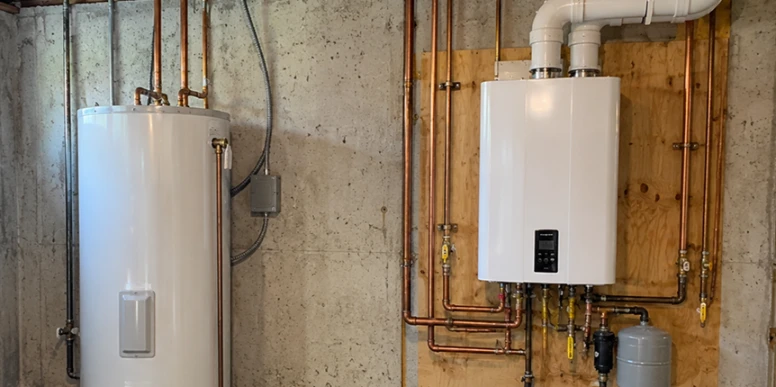
No hot water, lukewarm water, a rumble when it fires, or a damp patch that wasn’t there last week. Opus repairs, services and flushes gas and electric water heaters across Middlesex County and the Merrimack Valley, out of North Billerica. You get one flat price in writing before anything comes apart, the same as every job under plumbing services. If the tank still has years left in it, you’ll hear that instead of a quote.
Permit, inspection, and haul-away included.
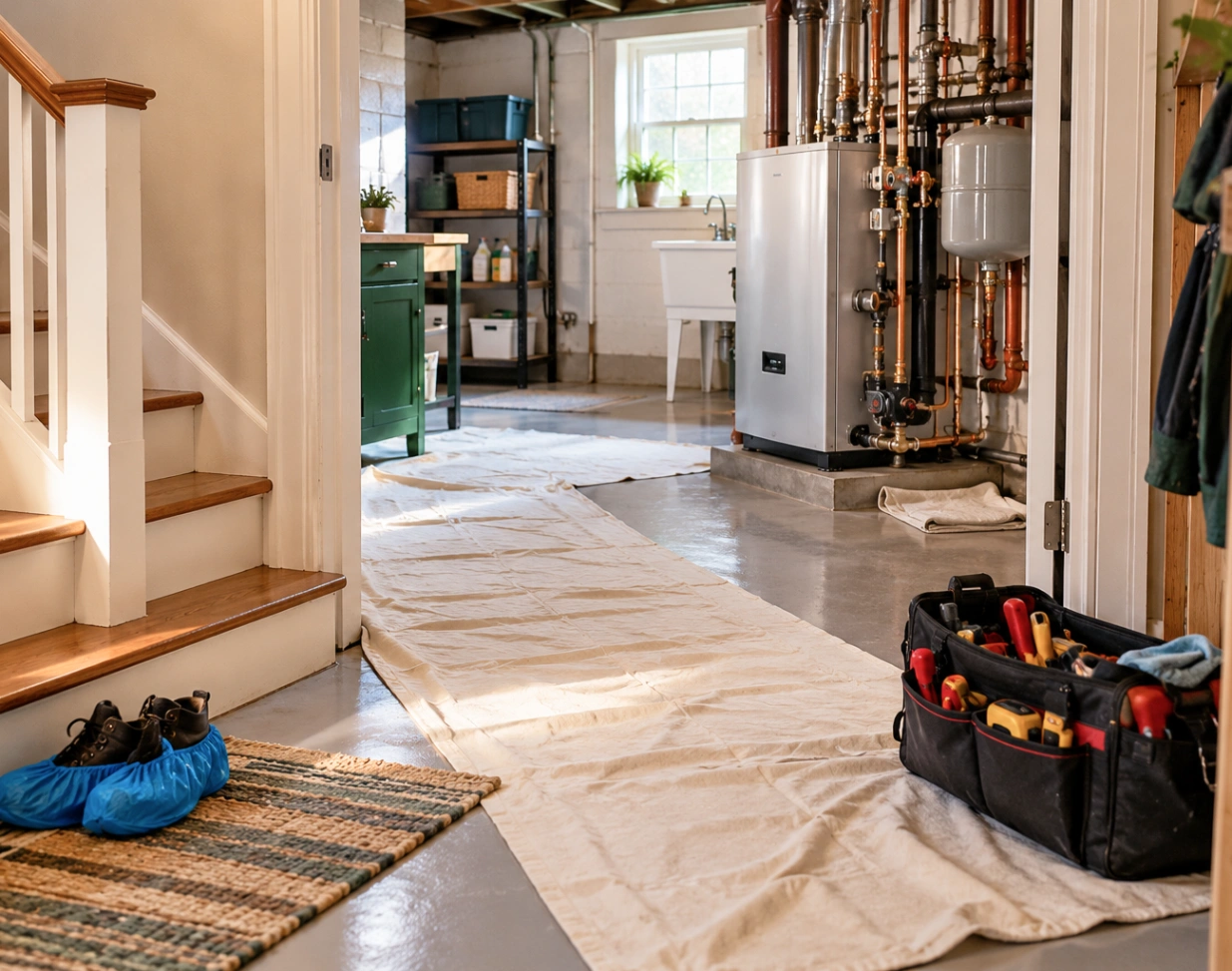
Booties on, floors covered, every visit.
Emergency help, around the clock.
Loading Form
Loading Form
No Hot Water? Start Here
Water Heater Not Heating, Gas and Electric
Five faults account for most of the calls. Which one you have usually shows in how the hot water failed rather than in the tank itself.
No hot water at all, gas heater.
Often the pilot or the igniter, sometimes the thermocouple, occasionally the gas control valve. The tank is usually fine. The thing that lights it isn’t.
No hot water at all, electric heater.
Usually a tripped high-limit switch or a failed upper element. The reset button behind the top panel is worth knowing about, though a heater that trips it twice is telling you something rather than asking to be reset.
Lukewarm water that never gets hot.
On electric, a dead lower element while the upper one carries on. On gas, a thermostat drifts or sediment insulates the burner from the water above it.
Hot water runs out faster than it used to.
Sediment is taking up volume in a tank that holds what it always did. This is the most common complaint we get and the most fixable.
No hot water in the shower, but fine at the taps.
Usually not the heater at all. That’s a mixing valve or a cartridge in the shower itself, and it’s a different, smaller job.
If water is actively running and you can’t stop it, shut the cold supply valve on top of the tank first, then call. A tank emptying itself at midnight is what 24/7 emergency plumbing is for, and a person picks up at that hour rather than a machine.
SUBMIT A FORM & REACH OUT
A Leak From the Bottom Is a Countdown
Why Your Water Heater Is Leaking
Where the water is coming from decides whether this is a repair or a replacement, and it’s the first thing we look at.
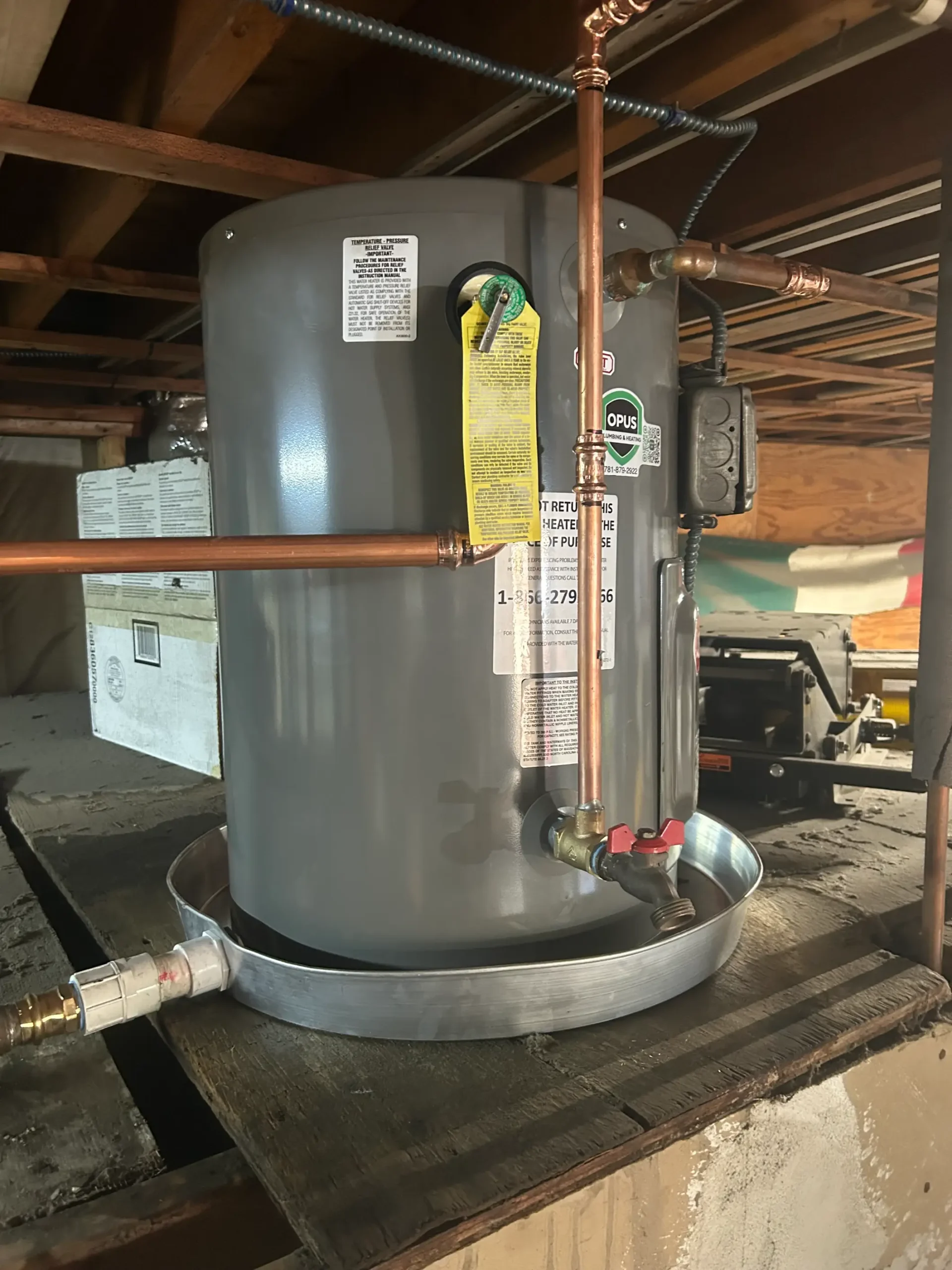
Leaking from a fitting or a valve is usually fixable.
The cold inlet, the hot outlet, the drain valve at the base, or the T&P relief valve on the side. Those are serviceable parts. A drain valve that weeps after somebody flushes the tank is common and inexpensive to sort.
Leaking from the bottom of the tank itself is not.
The steel has corroded through from the inside, and there is no patch for that. What you have is a countdown, and it usually runs in weeks rather than months. A tank that’s seeping today empties eighty-odd gallons into a finished basement at some point, and it tends to pick a bad moment.
A weeping T&P valve is its own thing.
It may be a failed valve, or it may be pressure in the system with nowhere to go, which is an expansion tank problem rather than a water heater one.
If the tank is going, replacement runs through water heater installation, where sizing, venting and the permit all get handled.
Most Tanks Out Here Have Never Been Flushed
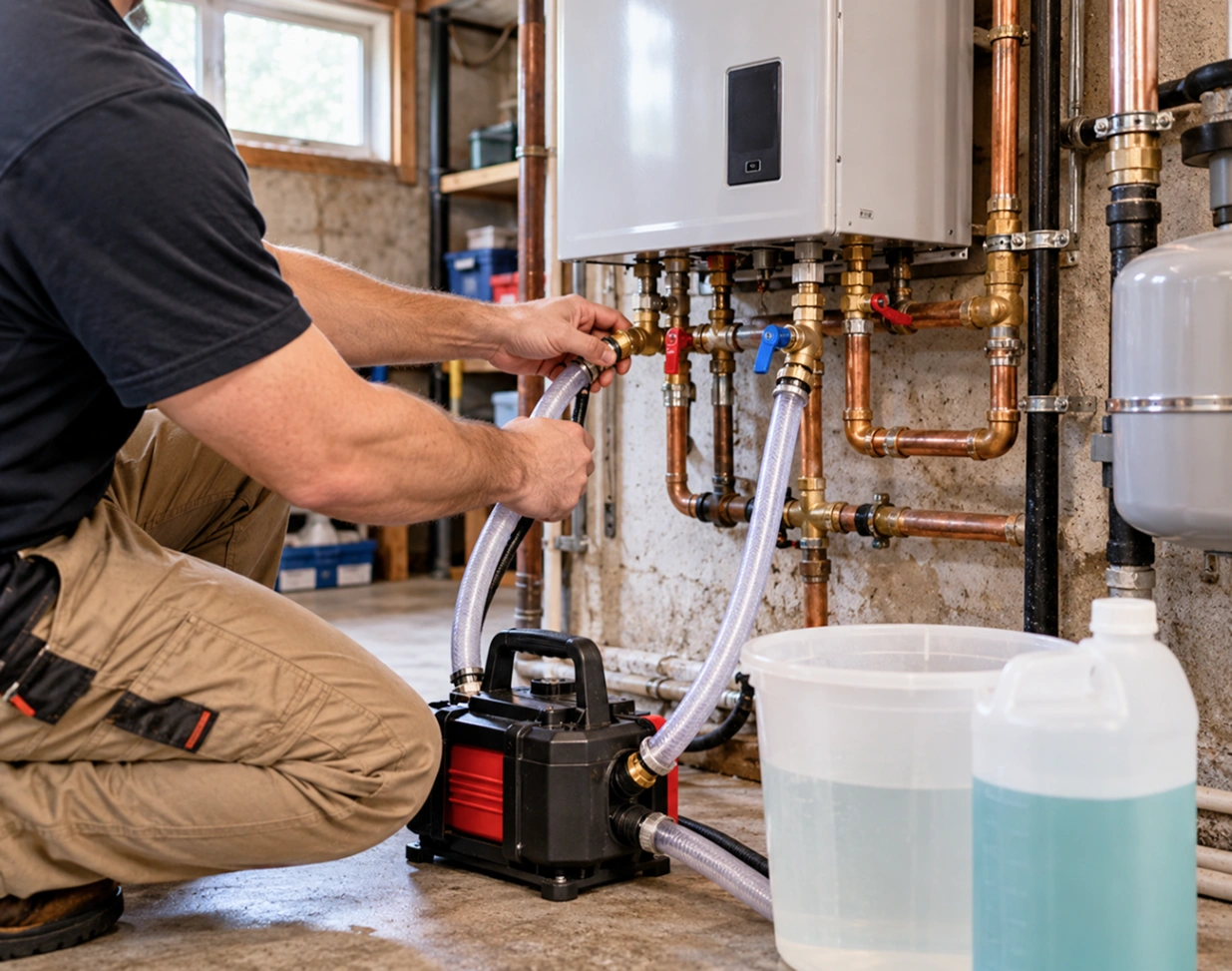
Water Heater Flushing and Sediment Removal
The water in much of this service area is hard enough that minerals drop out of it as it heats. They settle in the bottom of the tank and stay there.
What that costs you is capacity first, then efficiency, then the tank. Sediment takes up space, insulates the burner from the water it’s heating, and makes a gas heater run longer for the same shower. The popping and rumbling people describe is water flashing to steam underneath that layer.
A flush drains the tank and carries the loose sediment out with it.
On a tank that’s been done regularly it’s straightforward and takes under an hour, and our special offers currently include a $99 flush and full plumbing inspection that covers it alongside a walk of the rest of the house.
Here's the part that doesn't get said.
Flushing a heater that has never been flushed in ten years is not always a good idea. Hardened sediment can break loose and block the drain valve open, and an old plastic valve sometimes won’t reseat once it’s been turned. We’ll look at the age of the unit and tell you honestly whether flushing it is worth the risk or whether you’re better off leaving it alone and budgeting for a replacement. That’s not a conversation that earns us anything, which is rather the point.
How often?
Once a year on a tank heater in this area, and our maintenance plan gets members the member rate on it. If you have a tankless unit instead, the equivalent job is tankless descaling, and the manufacturers want it annually to keep the warranty intact.
The Part Nobody Mentions Until It's Gone
Inside your water heater there’s a metal rod doing a job you’ve probably never heard of. It’s called a sacrificial anode, and it exists to corrode so the tank doesn’t.
It works by being more attractive to corrosion than the steel around it.
For as long as the rod is there, it takes the damage. Once it’s eaten through, the corrosion moves on to the tank walls, and that’s the point the clock starts on the leak that ends the heater’s life.
Hard water eats it faster.
A rod that might last eight or nine years elsewhere can be gone in five here. It’s the single biggest reason a twelve-year-rated heater quits at seven, and almost nobody checks it.
Replacing one is cheap next to replacing a tank, and on a heater that’s five or six years old and otherwise healthy it can genuinely buy you years. On a tank that’s already rusting it buys you nothing, and we’ll say so rather than sell you the rod.
Two Things Bolted On That Also Fail
Thermal Expansion Tanks
If your T&P relief valve drips and the valve itself turns out to be fine, the cause is usually pressure with nowhere to go.
Most homes now have a backflow preventer or a pressure reducing valve on the incoming line, which makes the plumbing a closed system. Heat the water, it expands, and the pressure climbs until something gives. A thermal expansion tank absorbs that. When one fails, or was never fitted, the relief valve ends up doing the job instead and eventually wears out.
A failed expansion tank is a small part and a short visit. The install-side detail on sizing and charging sits on water heater installation.
Hot Water Recirculation Systems
A recirculating pump is what stops you running the tap for a minute before anything warm arrives, by keeping hot water moving through the line. They fail quietly. The pump seizes, a check valve sticks, or a timer or aquastat stops calling for it, and the first anyone notices is that the far bathroom is slow again. We service and replace pumps on existing systems, and we’ll tell you whether the problem is the pump or the control before anything gets swapped.
Repair It or Replace It?
How We Call It
There’s no formula, but there is a pattern, and it’s the same one we’d apply in our own house.
Under eight years, component failure.
Repair. A thermostat, an element, an igniter or a valve on a sound tank is worth fixing and the heater has years ahead of it.
Any age, leaking from a fitting.
Repair. Fittings and valves are serviceable parts and a leak there says nothing about the tank.
Past ten, rusty hot water or a seeping tank.
Replace. The steel is going and no repair changes that.
Eight to ten, second repair in two years.
Your call, and we’ll lay out both numbers. Often the honest answer is that the heater owes you nothing and you’d rather choose the timing than have February choose it.
We don’t work on oil-fired water heaters, and tankless units are a different page. Gas and electric tanks are what this covers.
The Call-It-Straight Standard
We Do Only the Work You Approved
Most people brace for the tech who finds four more things wrong and leans on them to fix all of it, and a water heater call is where that usually starts. We tell you what we see and what it costs if it fails, then do only what you approved. No packages, no pressure. Ricky said this himself, before anybody suggested it as a selling point: if he spots a water heater on its way out while he’s there for something simple, he points out the risk, asks what you want to do, and attends to what he was called for. That cuts the other way too. If your tank has five good years left, we’ll tell you that and flush it, rather than quoting you a replacement you don’t need yet.
Our Customer Feedback
Rick Green did an awesome job with all of my plumbing needs during a total renovation. I needed everything in my home connected/redone in the kitchen and bathroom. He took care of the transition from bathtub to standing shower-it’s all …
Janet Vasquez
July 2026
Ricky and the team at OPUS are fantastic! Super knowledgeable, punctual and all around great group of guys. Really grateful to have found them, I sleep easier now knowing I have a great plumbing team (you genuinely never know when you may …
Christopher
August 2026
I highly recommend (Rick) he was on time fixed everything, was polite and answered all our questions and cleaned up everything when he was done! Thank you so much!
Robert Welch
March 2026
Great service! Very responsive. Always on time and gets the job done quickly. Already have them booked for my next project.
carolina
April 2026
“Been using Opus for years on a variety of projects. Reliable, transparent and priced well. Rick does great quality work. Highly recommend for homeowners, investors and builders.”
Signature Page
May 2026
“Had a leak in my water heater tank. Ricky and team arrived very quickly, same day to assess the situation. I asked if we could avoid swapping out the water heater and just buy the parts needed to fix (I was being cheap!) – he did he absolute best (a few hours) trying to extract the old part and replace it with a new one. He tried far longer than any other plumber would have tried. After several hours of attempts we all came to the conclusion that it simply wasn’t coming out. I ran to Home Depot (it was Saturday) and grabbed a water heater. Ricky and team had it installed within 15 minutes and my new unit is working perfectly.
Very impressed with Ricky’s transparency and honesty. Most others wouldnt have given me the time of day…”
Dan Doherty
April 2026
I contacted Opus upon being referred to them by someone they also did great work for. They showed up on time and finished a heating system job for me with the utmost professionalism and quality. I would definitely recommend them to others!!
Brian Sullivan
October 2025
Ricky was Fantastic!!!! Fast and accurate service!!! Highly recommend!!!
Sandra Best
March 2026
I highly recommend (Rick) he was on time fixed everything, was polite and answered all our questions and cleaned up everything when he was done! Thank you so much!
Robert Welch
March 2026
Great service! Very responsive. Always on time and gets the job done quickly. Already have them booked for my next project.
carolina
April 2026
Rick Green did an awesome job with all of my plumbing needs during a total renovation. I needed everything in my home connected/redone in the kitchen and bathroom. He took care of the transition from bathtub to standing shower-it’s all …
Janet Vasquez
July 2026
Ricky and the team at OPUS are fantastic! Super knowledgeable, punctual and all around great group of guys. Really grateful to have found them, I sleep easier now knowing I have a great plumbing team (you genuinely never know when you may …
Christopher
August 2026
“Had a leak in my water heater tank. Ricky and team arrived very quickly, same day to assess the situation. I asked if we could avoid swapping out the water heater and just buy the parts needed to fix (I was being cheap!) – he did he absolute best (a few hours) trying to extract the old part and replace it with a new one. He tried far longer than any other plumber would have tried. After several hours of attempts we all came to the conclusion that it simply wasn’t coming out. I ran to Home Depot (it was Saturday) and grabbed a water heater. Ricky and team had it installed within 15 minutes and my new unit is working perfectly.
Very impressed with Ricky’s transparency and honesty. Most others wouldnt have given me the time of day…”
Dan Doherty
April 2026
“Been using Opus for years on a variety of projects. Reliable, transparent and priced well. Rick does great quality work. Highly recommend for homeowners, investors and builders.”
Signature Page
May 2026
Ricky was Fantastic!!!! Fast and accurate service!!! Highly recommend!!!
Sandra Best
March 2026
I contacted Opus upon being referred to them by someone they also did great work for. They showed up on time and finished a heating system job for me with the utmost professionalism and quality. I would definitely recommend them to others!!
Either a fitting above it is dripping and running down, or the tank itself has corroded through. The first is a repair. The second isn’t repairable at all, and it means the heater is near the end. We check which before quoting anything, because the two answers are very different.
How often should a water heater be flushed?
Once a year in this area, because the water is hard enough to drop sediment steadily. If yours hasn’t been done in a decade, tell us the age before we start. Flushing a long-neglected tank carries a real risk of the drain valve failing, and sometimes leaving it alone is the better call.
Why do I have no hot water in the shower but hot water everywhere else?
That’s usually the shower, not the heater. A mixing valve or a worn cartridge limits how much hot reaches that one fixture. Smaller job, different fix, and worth ruling in before anyone touches the tank.
What is an anode rod and does mine need replacing?
It’s a metal rod inside the tank that corrodes in place of the steel. Hard water wears it out faster, often in five years rather than nine. On a healthy tank that’s five or six years old, replacing it can add real life. On a tank that’s already rusting, it won’t help and we’ll say so.
Can you repair a tankless water heater or a boiler?
Tankless units and boilers are both work we do, just not on this page. Tankless has its own page, and boilers run through the heating side of the site.
“Clear answers. One written price. You decide before we start.”
Opus runs out of North Billerica and covers roughly a 20-mile radius, from the older neighborhoods of Woburn and Winchester to the affluent, boiler-heavy homes in Concord, Carlisle, and Lincoln. If your home is within about 20 miles, we most likely cover you.
Tips for Keeping Your Water Hot and Your Basement Dry
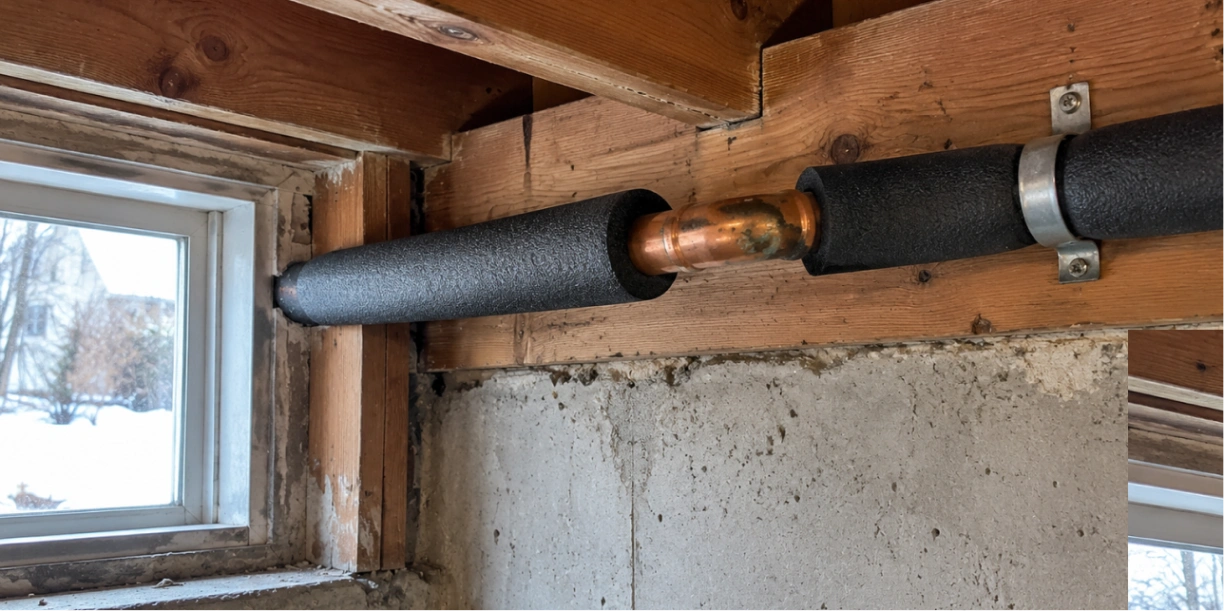
It’s about to get cold
Which pipes freeze first, what to do in
October so they don’t, and what to do at two
in the morning if one already has. Frozen and
burst pipes covers all of it.
Stains, a meter still ticking with every tap shut off,
a warm patch of floor. Leak detection finds where the water is actually coming from before anybody opens a wall.
How often hot water and steam systems want servicing, what the annual visit includes, and which noises are worth calling about. Boiler service and repair answers all three.
Age, rusty water, a puddle, or hot water that runs out sooner than it used to. Four signs that point the same way, and water heater installation is what comes next.