Tankless Water Heater Installation in Middlesex County, MA
Endless Hot Water, If the House Can Take It
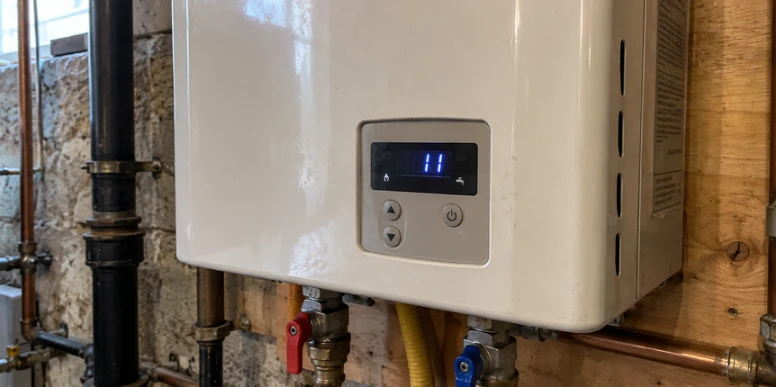
Tankless is one of the plumbing services Opus runs out of North Billerica, across Middlesex County and the Merrimack Valley. We install Rinnai and Navien. The unit heats water as it passes through, so it never runs out and doesn’t take up floor space, but it asks more of your gas line and your venting than a tank does. We check whether your house can carry one before quoting it, not after. Our special offers currently include $400 off a tankless upgrade.
Permit, inspection, and haul-away included.
Booties on, floors covered, every visit.
Emergency help, around the clock.
Loading Form
Loading Form
Is a Tankless Water Heater Worth It?
Tankless vs Tank Water Heaters
It depends on the house and on what’s annoying you. Five things decide it, and not all of them point the same way.
You stop running out.
This is the real reason people switch. A tankless unit heats on demand, so back-to-back showers and a dishwasher don’t drain a reservoir that then needs an hour to recover. If your complaint is the third shower going cold, this fixes it permanently.
You get the floor space back.
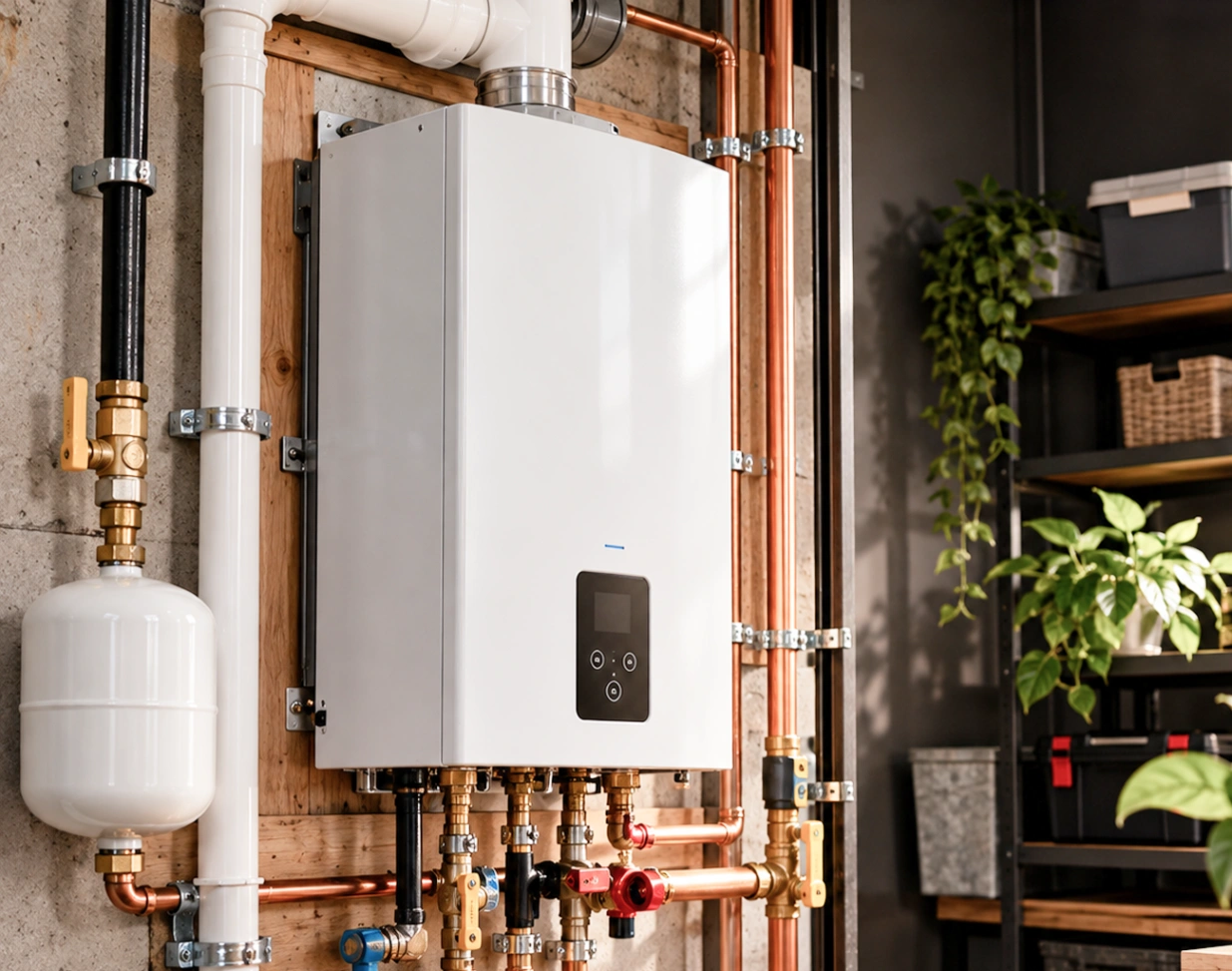
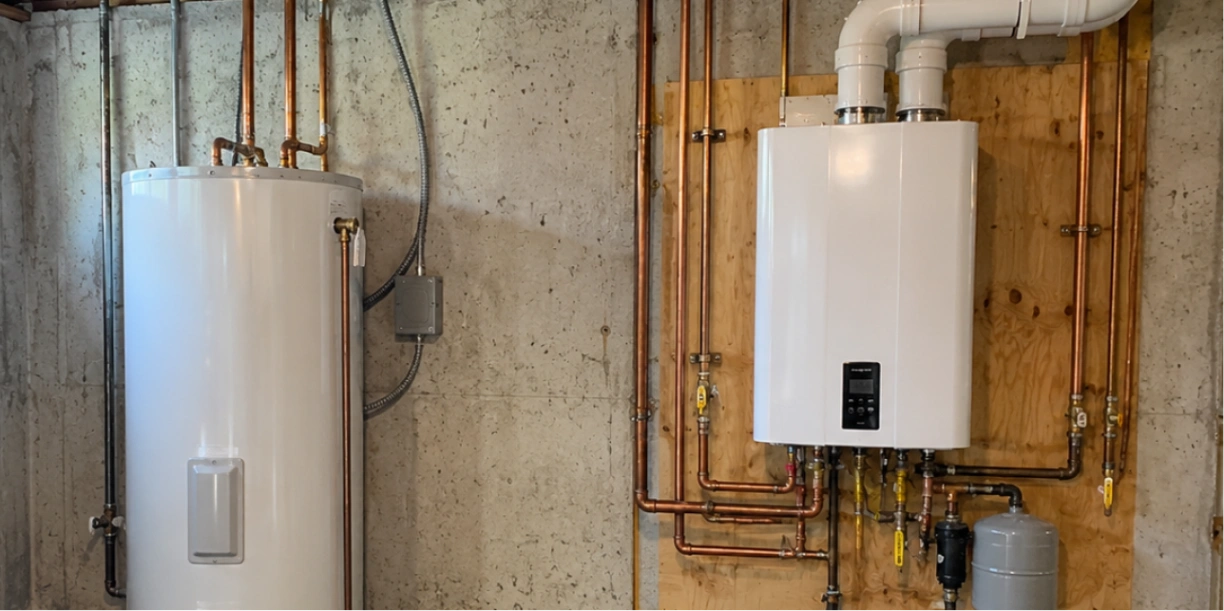
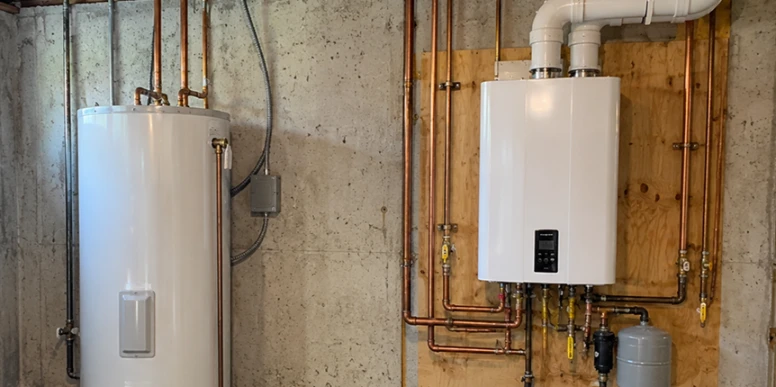
A tank takes a corner of the basement. A tankless unit hangs on the wall and is roughly the size of a carry-on case. In a finished basement or a tight utility room that matters more than the efficiency numbers.
It costs more up front.
Both the unit and the installation. Venting usually changes, the gas line often has to be upsized, and the condensate needs somewhere to go. It isn’t a like-for-like swap and pricing it as one is how people end up surprised.
It has to be serviced every year.
Not optional, and covered properly below. A tank you can neglect for a decade and it’ll limp on. A tankless unit in this water will start throwing codes.
It lasts longer if you look after it.
A tank heater runs 8 to 12 years. A well-maintained tankless unit commonly goes to 20. That’s the trade: more attention, more years.
If what you actually need is a straightforward replacement, a tank is often the better spend and we’ll say so. Water heater installation rarely means changing the venting or upsizing the gas line, which is most of why it costs less.
SUBMIT A FORM & REACH OUT
Endless Hot Water Has Conditions
What Your House Needs to Run One
Three things decide whether a tankless unit fits your house, and all three get checked before anyone quotes you.
Somewhere to vent.
Condensing units vent through a side wall in PVC, which is usually straightforward. What you can’t do is push tankless exhaust up an old chimney flue that was sized for a tank.
Somewhere for condensate to drain.
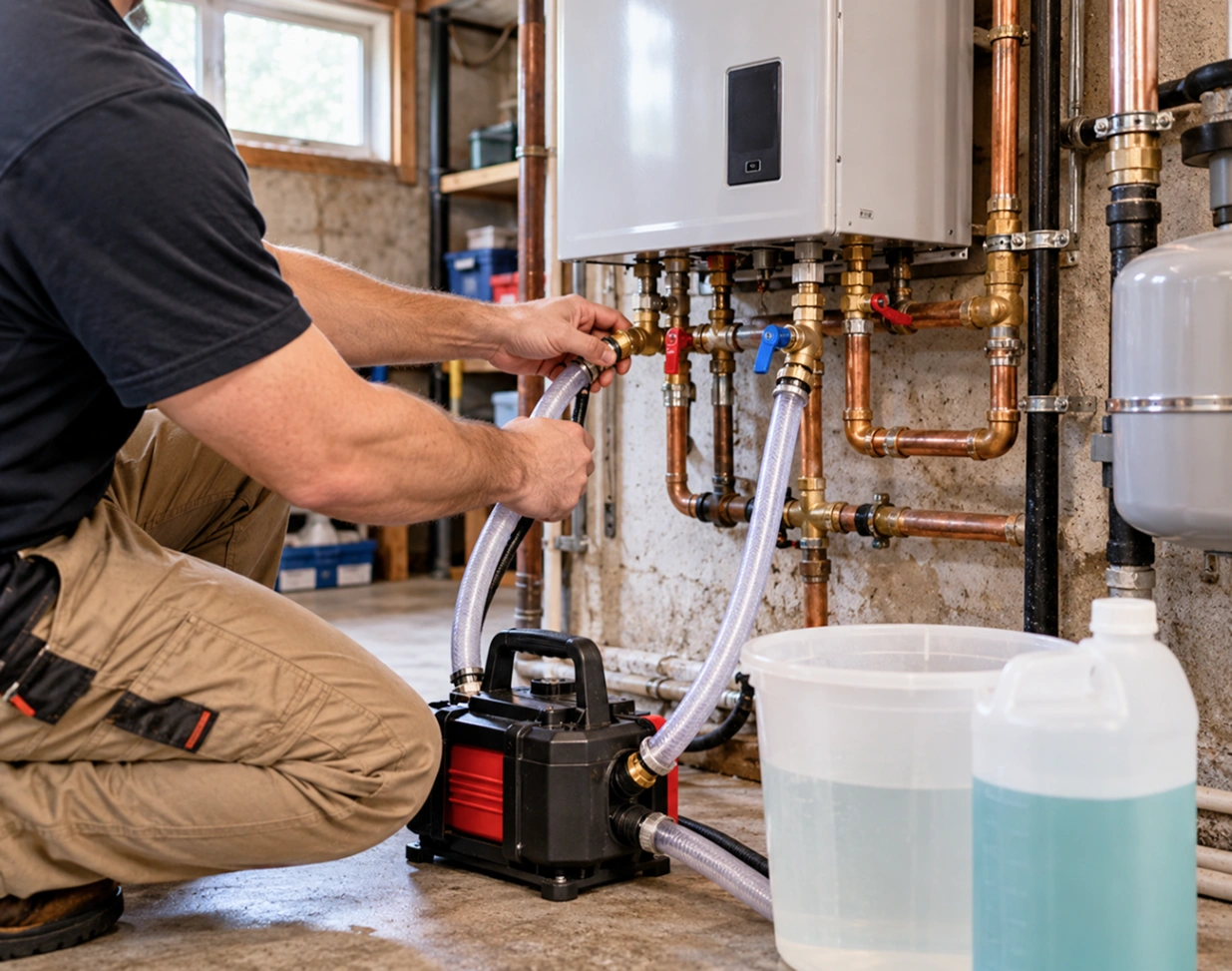
A condensing unit produces acidic water as a by-product. It needs a drain and usually a neutraliser. In a basement with no nearby drain that means a condensate pump, which is a small cost but not nothing.
Water hardness you plan around.
The water in much of this area drops scale, and scale coats a heat exchanger faster than it coats a tank. That doesn’t rule tankless out. It decides the service schedule.
Gas Supply and Venting
This is the one that catches people, and it’s where a cheap quote usually turns expensive halfway through.
A gas tank heater draws somewhere around 40,000 BTU. A whole-house tankless unit wants 150,000 to 199,000. That is four to five times the demand on the same pipe, and a house piped decades ago for a tank, a stove and a dryer frequently cannot carry it.
Sometimes the fix is upsizing a run. Sometimes it’s the meter or the main. Either way we do that arithmetic before handing you a number, so it appears in the written price rather than as a phone call from your cellar on install day.
Rinnai and Navien Tankless Water Heaters
Condensing and Non-Condensing Units
Rinnai and Navien are what Opus installs. Both are widely used in New England, both are well supported for parts, and both have straightforward service requirements, which matters more over twenty years than any efficiency figure on a brochure.
Condensing units
Condensing units pull a second round of heat out of the exhaust before it leaves, which is why they run more efficiently and vent in PVC rather than metal. They’re what gets installed in most homes now. The trade-off is the condensate drain.
Non-condensing units
Non-condensing units are simpler and cheaper, vent in stainless, and suit particular situations rather than being the default. If one is the right answer for your house we’ll tell you, but it usually isn’t.
Both makers also build combi units, which handle your heating and your hot water from one box. That’s a boiler rather than a water heater, so it lives on the heating side. If that’s the direction you’re considering, start at boiler replacement.
Electric Tankless, and Where It Actually Fits
Worth being straight about this one, because the search results are misleading.
A point-of-use electric tankless unit under a sink, feeding one fixture, works well and is a genuinely useful thing. A whole-house electric tankless unit is a different proposition. It needs an electrical service most older homes around here simply don’t have, often several dedicated high-amperage circuits and a panel upgrade to match.
In the housing stock we work in, gas is almost always the answer for whole-house tankless. If you have no gas at the street, a heat pump water heater is usually a better route than electric tankless, and that’s covered on the installation page.
It Needs Servicing Every Year, and We'd Rather Say That Now
A tankless unit is not a fit-and-forget appliance, and anybody selling you one without mentioning this is setting you up.
Scale from hard water coats the heat exchanger. As it builds, the unit short-cycles, then starts throwing fault codes, and the owner concludes that tankless was a mistake. It wasn’t. It needed descaling.
Rinnai and Navien both call for roughly annual descaling, and both will ask for service records if you make a warranty claim. Most homeowners find that out on the day they need the warranty, which is the worst possible moment.
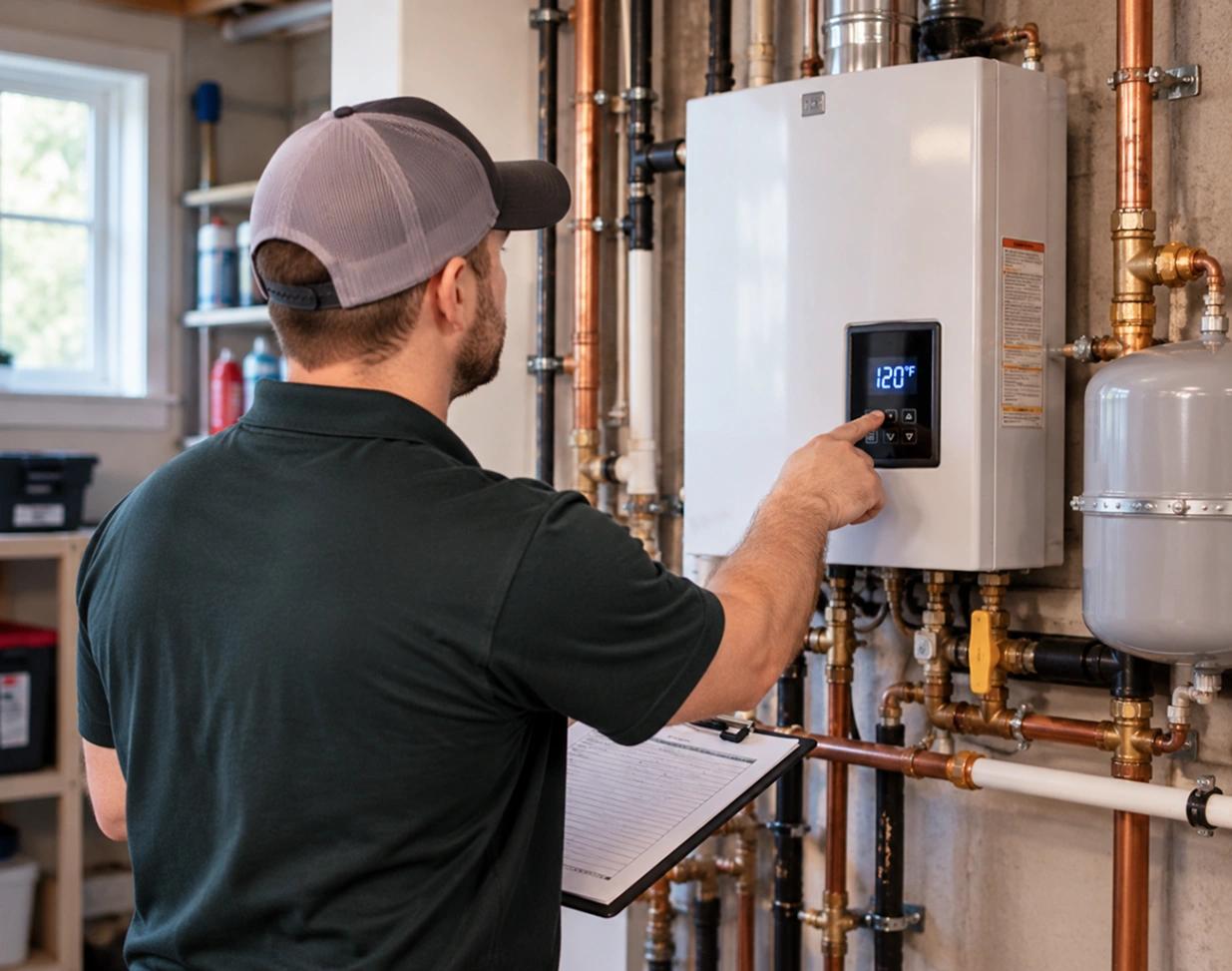
So we say it before you buy rather than after: budget for one service visit a year, the same way you would for a boiler. Tankless descaling takes under two hours and nothing in the house comes apart. Our maintenance plan puts it at the member rate.
What the Install Day Looks Like
Removing the Old Tank
A straightforward tank-to-tankless conversion is usually a single day. Here’s the shape of it.
The old tank comes out first.
Drained, disconnected and carried out. It leaves in our truck, not onto your curb waiting for a dump run.
Gas, water and venting get run.
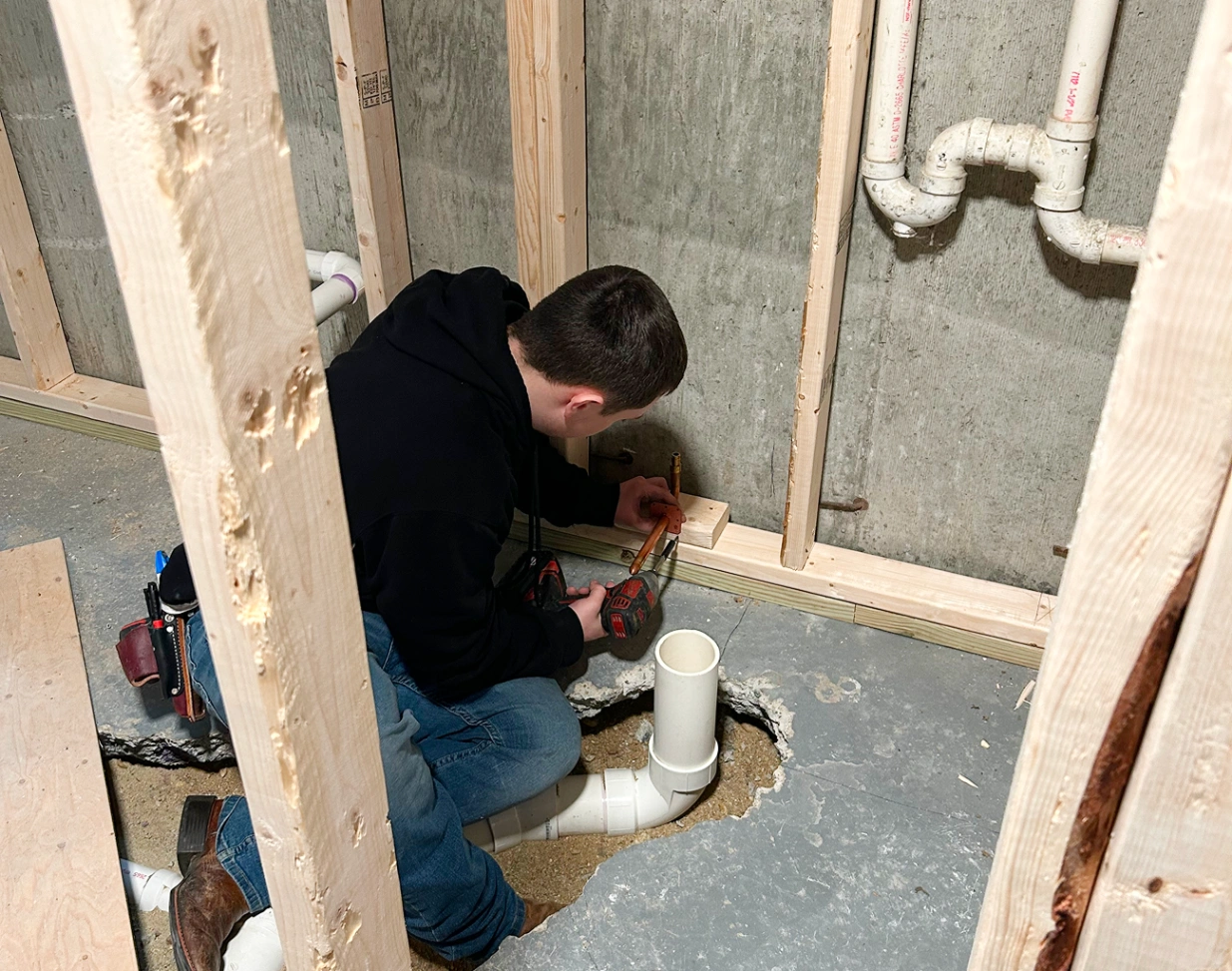
New venting through the wall, gas line sized or upsized as the quote specified, water lines and isolation valves fitted so future servicing doesn’t mean cutting pipe.
The unit goes on the wall and gets commissioned
Mounted, connected, condensate routed, then fired and checked under load rather than just switched on.
Permit pulled, inspection scheduled.
Both are inside the written price, and you end up holding the signed card. You’re not billed by the hour while we wait on your town’s inspector.
How Long a Tankless Unit Lasts
Commonly around 20 years, against 8 to 12 for a tank heater, and that gap is the honest financial argument for the upgrade rather than the efficiency figures.
The caveat is the whole of the section above. Twenty years assumes it gets descaled annually. A neglected unit in hard water will not see twenty, and the manufacturer will point at the service records when you ask them about it.
Heat exchangers on both brands carry long manufacturer warranties, and our own year on labor and materials sits on top of that. If the up-front number is the obstacle, financing through Wisetack spreads it monthly.
The Clean House Promise
How We Leave Your Home After an Install
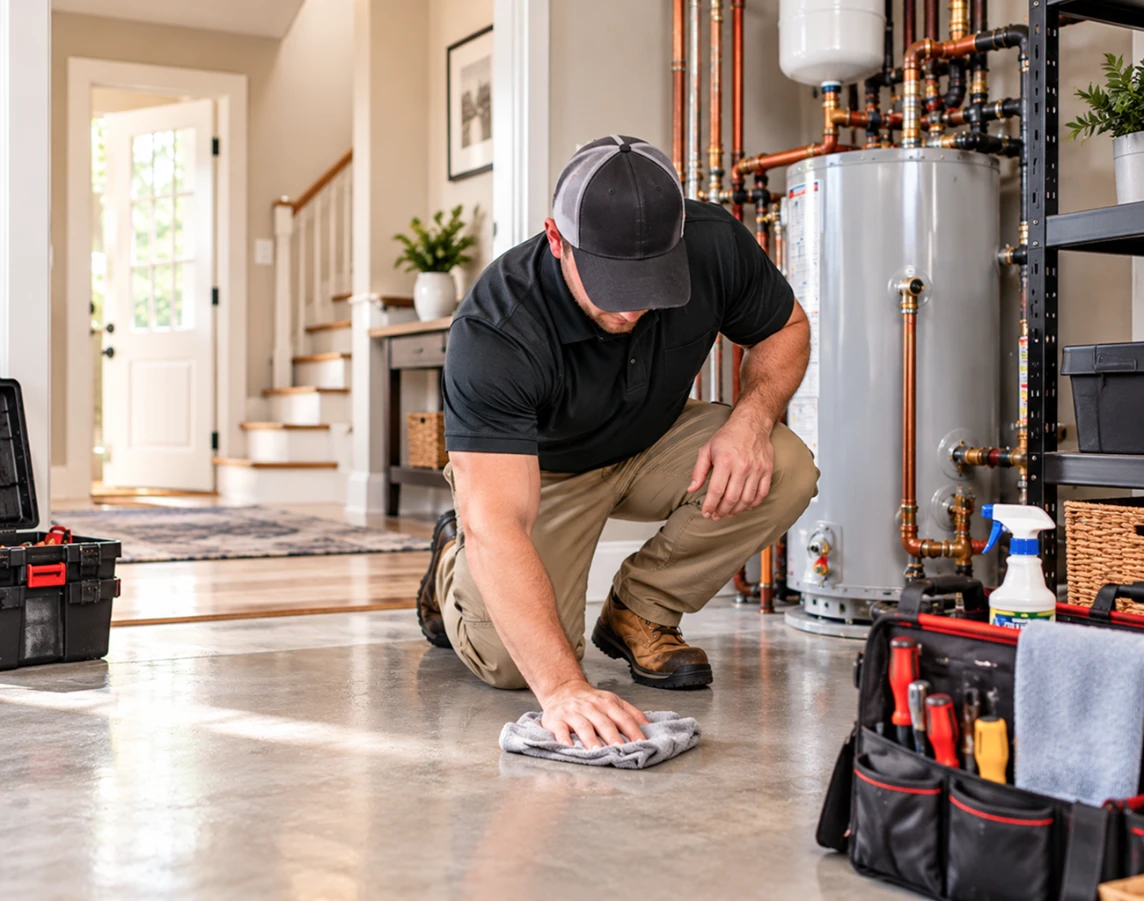
A tank-to-tankless conversion is a full day in your house, in and out of the basement, with an eighty-gallon tank coming out through your hallway. Booties go on at the door, every visit, including the ten-minute ones. Drop cloths go down before anything comes apart, along the route as well as under the work. The old tank leaves in our truck, drained, not sitting on your lawn waiting for a Saturday. Before we pack up, the floor where we stood gets wiped. When we pull out, you should be able to tell what we fixed and nothing else.
Our Customer Feedback
Rick Green did an awesome job with all of my plumbing needs during a total renovation. I needed everything in my home connected/redone in the kitchen and bathroom. He took care of the transition from bathtub to standing shower-it’s all …
Janet Vasquez
July 2026
Ricky and the team at OPUS are fantastic! Super knowledgeable, punctual and all around great group of guys. Really grateful to have found them, I sleep easier now knowing I have a great plumbing team (you genuinely never know when you may …
Christopher
August 2026
I highly recommend (Rick) he was on time fixed everything, was polite and answered all our questions and cleaned up everything when he was done! Thank you so much!
Robert Welch
March 2026
Great service! Very responsive. Always on time and gets the job done quickly. Already have them booked for my next project.
carolina
April 2026
“Been using Opus for years on a variety of projects. Reliable, transparent and priced well. Rick does great quality work. Highly recommend for homeowners, investors and builders.”
Signature Page
May 2026
“Had a leak in my water heater tank. Ricky and team arrived very quickly, same day to assess the situation. I asked if we could avoid swapping out the water heater and just buy the parts needed to fix (I was being cheap!) – he did he absolute best (a few hours) trying to extract the old part and replace it with a new one. He tried far longer than any other plumber would have tried. After several hours of attempts we all came to the conclusion that it simply wasn’t coming out. I ran to Home Depot (it was Saturday) and grabbed a water heater. Ricky and team had it installed within 15 minutes and my new unit is working perfectly.
Very impressed with Ricky’s transparency and honesty. Most others wouldnt have given me the time of day…”
Dan Doherty
April 2026
I contacted Opus upon being referred to them by someone they also did great work for. They showed up on time and finished a heating system job for me with the utmost professionalism and quality. I would definitely recommend them to others!!
Brian Sullivan
October 2025
Ricky was Fantastic!!!! Fast and accurate service!!! Highly recommend!!!
Sandra Best
March 2026
I highly recommend (Rick) he was on time fixed everything, was polite and answered all our questions and cleaned up everything when he was done! Thank you so much!
Robert Welch
March 2026
Great service! Very responsive. Always on time and gets the job done quickly. Already have them booked for my next project.
carolina
April 2026
Rick Green did an awesome job with all of my plumbing needs during a total renovation. I needed everything in my home connected/redone in the kitchen and bathroom. He took care of the transition from bathtub to standing shower-it’s all …
Janet Vasquez
July 2026
Ricky and the team at OPUS are fantastic! Super knowledgeable, punctual and all around great group of guys. Really grateful to have found them, I sleep easier now knowing I have a great plumbing team (you genuinely never know when you may …
Christopher
August 2026
“Had a leak in my water heater tank. Ricky and team arrived very quickly, same day to assess the situation. I asked if we could avoid swapping out the water heater and just buy the parts needed to fix (I was being cheap!) – he did he absolute best (a few hours) trying to extract the old part and replace it with a new one. He tried far longer than any other plumber would have tried. After several hours of attempts we all came to the conclusion that it simply wasn’t coming out. I ran to Home Depot (it was Saturday) and grabbed a water heater. Ricky and team had it installed within 15 minutes and my new unit is working perfectly.
Very impressed with Ricky’s transparency and honesty. Most others wouldnt have given me the time of day…”
Dan Doherty
April 2026
“Been using Opus for years on a variety of projects. Reliable, transparent and priced well. Rick does great quality work. Highly recommend for homeowners, investors and builders.”
Signature Page
May 2026
Ricky was Fantastic!!!! Fast and accurate service!!! Highly recommend!!!
Sandra Best
March 2026
I contacted Opus upon being referred to them by someone they also did great work for. They showed up on time and finished a heating system job for me with the utmost professionalism and quality. I would definitely recommend them to others!!
If you keep running out of hot water or you want the basement space back, yes. If you simply need a failed heater replaced and neither of those bothers you, a tank is usually the better spend and we’ll tell you so. The other half of the answer is whether you’ll keep up with annual servicing, because that decides whether you get twenty years or eight.
How long do tankless water heaters last?
Commonly around 20 years with annual descaling, against 8 to 12 for a tank. Skip the servicing in water as hard as ours and that figure drops considerably, and the manufacturer will ask for service records if you claim on the warranty.
Do I need a bigger gas line for a tankless water heater?
Often, yes. A gas tank heater draws around 40,000 BTU and a whole-house tankless wants 150,000 to 199,000. We run that calculation before quoting, so if a line or a meter needs upsizing it’s in the written price from the start rather than discovered on install day.
Can I put in an electric tankless water heater instead?
Under a single sink, yes, and it works well. Whole-house electric tankless needs an electrical service most older homes here don’t have, usually several dedicated high-amperage circuits plus a panel upgrade. If there’s no gas at the property, a heat pump water heater is normally the better route.
Rinnai or Navien?
Both are solid and we install both. The choice usually comes down to the configuration your house needs, venting route, and what’s available when you’re ready rather than one brand beating the other. We’ll tell you if a particular model suits your setup better and why.
“Clear answers. One written price. You decide before we start.”
Opus runs out of North Billerica and covers roughly a 20-mile radius, from the older neighborhoods of Woburn and Winchester to the affluent, boiler-heavy homes in Concord, Carlisle, and Lincoln. If your home is within about 20 miles, we most likely cover you.
Tips for Keeping Your Water Hot and Your Basement Dry
It’s about to get cold
Which pipes freeze first, what to do in
October so they don’t, and what to do at two
in the morning if one already has. Frozen and
burst pipes covers all of it.
Stains, a meter still ticking with every tap shut off,
a warm patch of floor. Leak detection finds where the water is actually coming from before anybody opens a wall.
How often hot water and steam systems want servicing, what the annual visit includes, and which noises are worth calling about. Boiler service and repair answers all three.
Age, rusty water, a puddle, or hot water that runs out sooner than it used to. Four signs that point the same way, and water heater installation is what comes next.