Tankless Water Heater Descaling in Middlesex County, MA

The Service That Decides Whether You Get Twenty Years

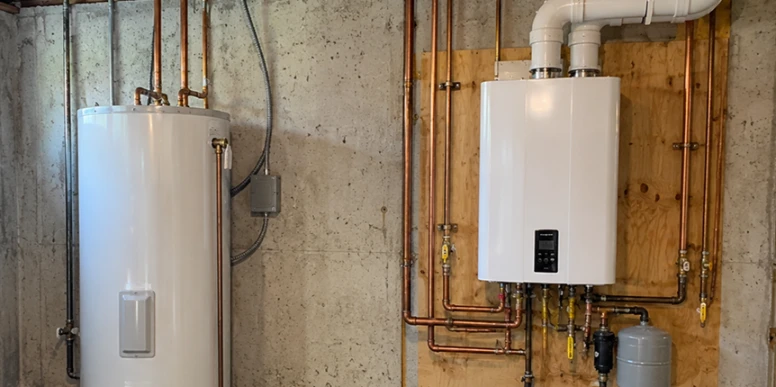
A tankless water heater is the one appliance in the house that asks for something back. Scale from hard water coats the heat exchanger, the unit starts short-cycling and throwing codes, and the owner decides tankless was a mistake. Opus descales and flushes Rinnai, Navien and other tankless units across Middlesex County and the Merrimack Valley, out of North Billerica. Every other job on our plumbing services list starts with something breaking. This is the one you book while the unit is still running fine. Once a year, one flat price in writing.

Request Ticket
How Can We Help?
Customer Info
Who is this for?
Only used to confirm your request.
Customer Info
Your email
Only used to confirm your request.
Customer Info
Your phone or mobile number
Only used to confirm your request.
Visit Details
Where should the team go?
Final Note
Anything we should know?
Loading Form

Scale Is Why Tankless Units Get a Bad Name

What Descaling a Tankless Water Heater Does

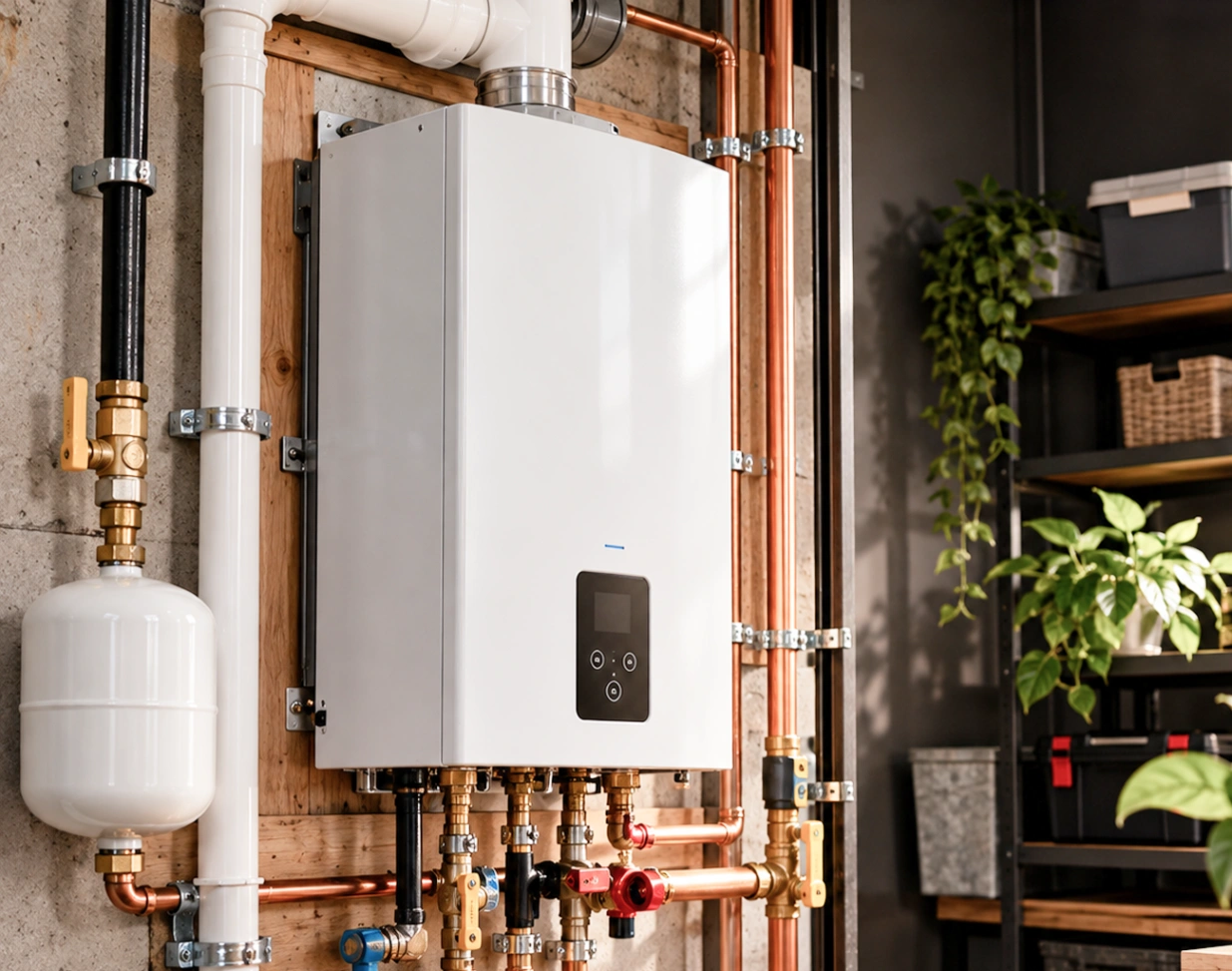
Inside a tankless unit is a heat exchanger with narrow passages that water moves through fast while the burner heats it. That combination, hot metal and moving water, is exactly what makes minerals drop out of solution and stick.


A tank heater tolerates this for years because the sediment just sits in the bottom of a large vessel. A tankless unit doesn’t have a bottom to collect it in. The scale builds directly on the surfaces doing the heating, and it builds where the passages are narrowest.


Descaling circulates a mild acidic solution through those passages to dissolve what’s built up, then flushes it out. It isn’t a repair and it isn’t a deep clean. It’s the equivalent of an oil change: routine, quick, and the difference between the unit reaching twenty years and the unit failing early.

SUBMIT A FORM & REACH OUT

Is Your Unit Telling You It's Due?

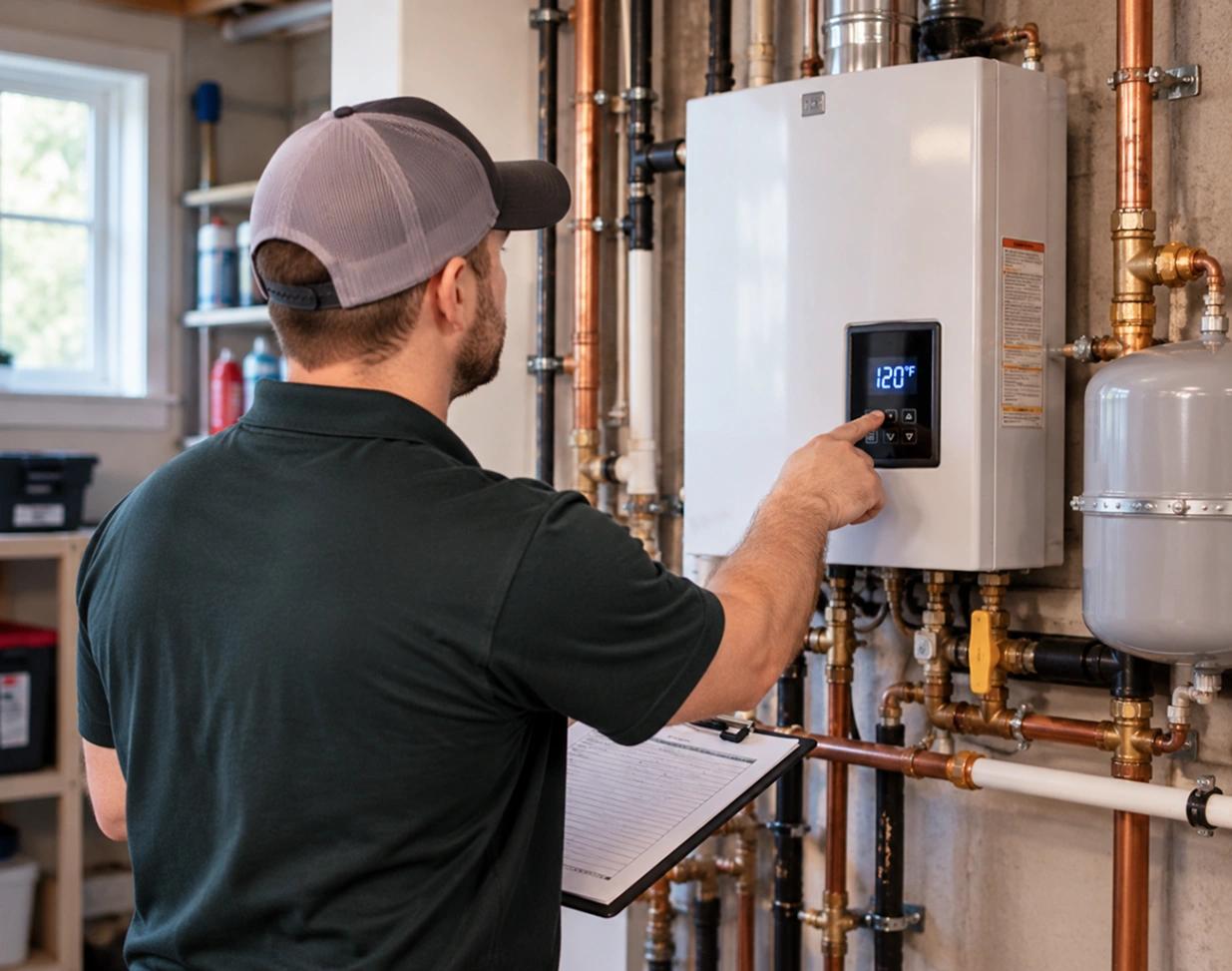
Short Cycling, Error Codes and Fluctuating Temperature

A scaled unit rarely stops dead. It degrades, and the symptoms are specific enough to recognise.

Short cycling

The burner fires, runs briefly, cuts out, then fires again. Scale is insulating the exchanger so the unit overshoots its target temperature, backs off, and repeats. It’s the earliest reliable sign.

An error code on the display

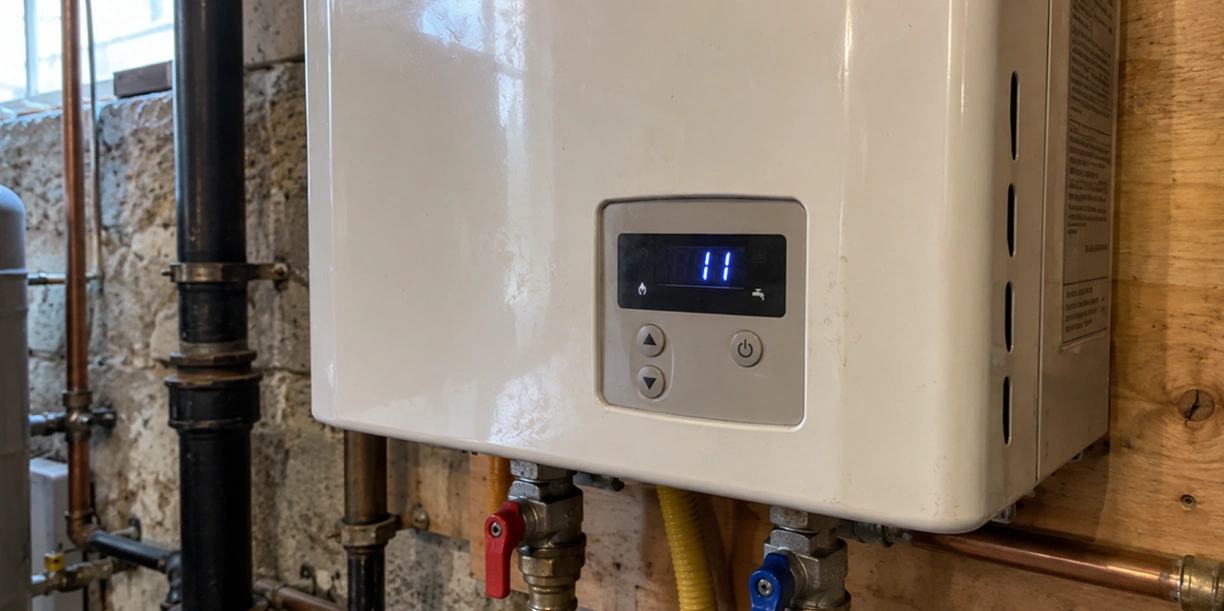
Both Rinnai and Navien will throw a code before they fail outright. Write down what it says before you reset it, because the code tells us where to look and resetting clears the history.

Temperature swinging in the shower

Warm, then hot, then cooler, without anyone touching a tap elsewhere.
The unit is struggling to hold its setpoint through a restricted exchanger.

Reduced flow at the hot taps

Cold pressure is fine, but hot is noticeably weaker. Scale narrowing passages restricts what can physically get through.

It takes longer to get hot than it did

A slow drift you only notice in hindsight. Usually the one people mention last and the one that’s been happening longest.

None of these mean the unit is finished. Almost all of them mean it’s overdue.

The Warranty Asks for Records Nobody Keeps

Tankless Water Heater Warranty and Annual Service

Rinnai and Navien both call for roughly annual descaling as a condition of keeping their warranty intact. Heat exchangers carry long manufacturer coverage, which is a genuine selling point when you buy. That coverage assumes the unit was maintained.


When a claim goes in, the manufacturer asks for service records. Most homeowners don’t have any, because nobody told them at the point of sale that they’d need them. A unit that failed at year nine with no documented service is a conversation you don’t want to be having.


So we keep the record for you. Every descale is dated and logged against your address,
so if you ever have to prove the unit was serviced, we can produce it rather than you having to go looking for a receipt.

How Often to Descale a Tankless Water Heater

Town Water and Well Water Across the Service Area

Once a year is the working answer for most of this service area, and it’s what the manufacturers ask for.


The honest refinement is that hardness varies across the towns we cover, and the right interval follows the water rather than the calendar. Municipal supply across the core towns sits in a moderate range. That’s still enough to scale a heat exchanger over twelve months, which is why annual holds as the default.


Well water is a different conversation. Carlisle and Groton are largely on wells, Westford partly, and private wells in this region can run considerably harder than town supply. On a well, annual is a floor rather than a target, and some units want looking at more often. We’d rather set that interval after seeing what comes out of the unit the first time than guess at it now.


Our service areas run to fourteen towns, and the water is not the same in all of them.

What the Visit Involves

Under two hours in most cases, and nothing in your house gets taken apart.

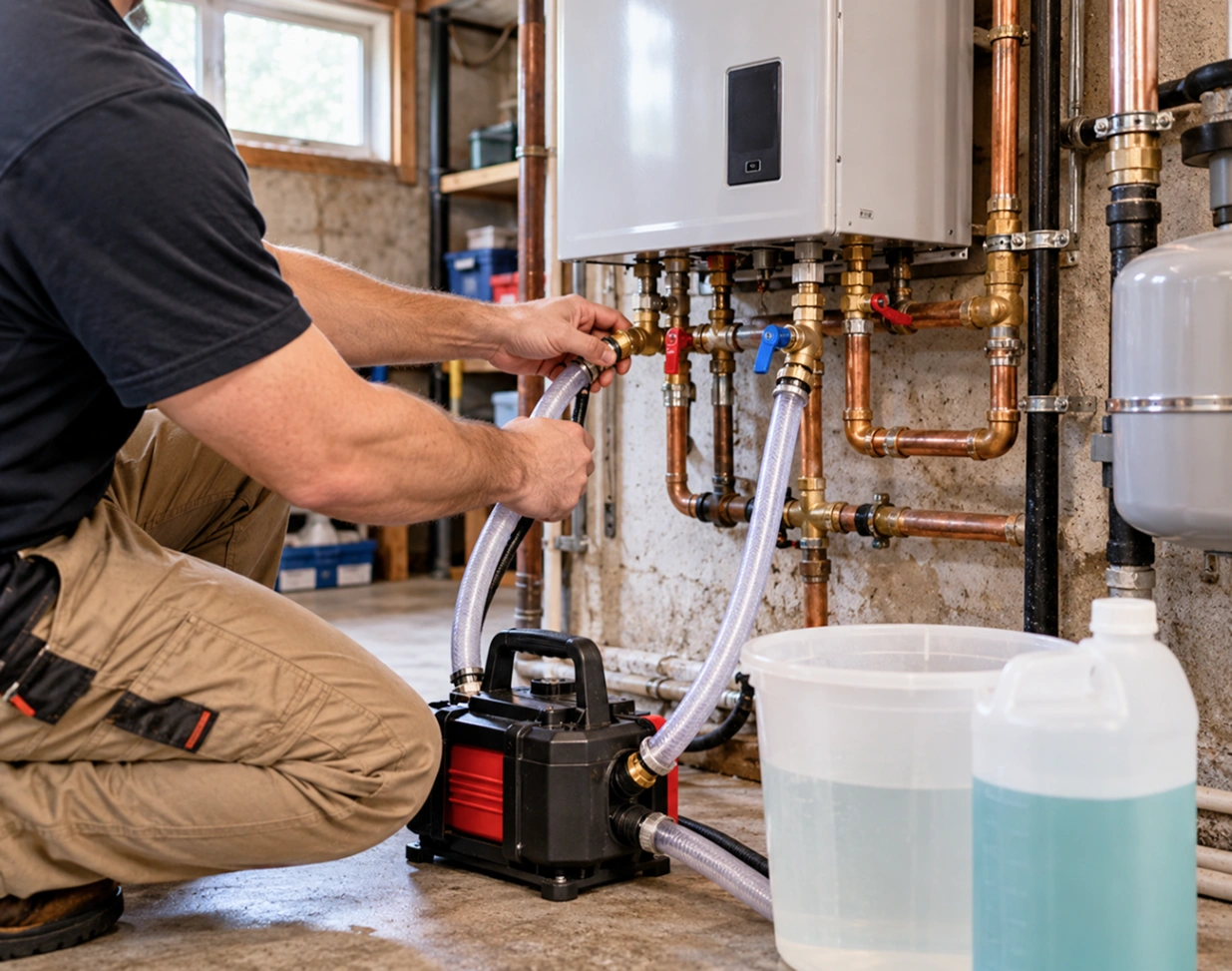
Isolate and connect

The service valves on either side of the unit get closed and a pump and hoses connect to the service ports. If your installer fitted isolation valves, this takes minutes.

Circulate the solution

A mild descaling solution runs through the heat exchanger in a loop,
typically for 45 minutes to an hour, dissolving the build-up rather than blasting it.

Flush and clean the filters

The solution comes out, clean water goes through, and the inlet screen gets pulled and rinsed. That screen catches debris and gets overlooked constantly.

Fire it and check it

Back into service, run under load, temperature and cycling verified before
we pack up. Then the visit gets recorded against your address.

One thing worth knowing if somebody else put your unit in.

Descaling needs isolation valves on the water lines. If they weren’t fitted at the time, the service means cutting pipe and adding them before anything else can happen. We fit them as standard whenever we install tankless water heaters, for exactly this reason. If yours doesn’t have them, we’ll tell you what adding them involves before we start rather than discovering it with your water off.

Treating the Water Instead of the Symptom

Water Softeners and Filtration Systems

Descaling deals with what’s already built up. Water treatment deals with why it builds up. A softener exchanges the minerals that cause scale before the water reaches any of your equipment. Filtration handles sediment, taste and other contaminants, which is a related but separate job. Both protect the tankless unit,
and both protect everything downstream of it as well.

Often, no. On municipal water in the core towns, annual descaling handles the problem perfectly well and a softener is more equipment than the situation calls for. It’s a real cost with ongoing salt and maintenance, and we’re not going to recommend one because you happen to own a tankless unit.

Harder water, no treatment upstream, and scale affecting the tankless unit, the fixtures and anything else it touches. That’s where treatment earns its keep. We install water filtration systems, and we’ll tell you honestly which side of that line your house sits on. If descaling once a year is enough, that’s what we’ll say.

The No-Surprise Number

One Flat Price, in Writing, Before Work Starts

Most quotes start with an hourly clock you can’t see, then add trip charges and parts marked up somewhere you’d have to ask three questions to find. We hand you one flat number in writing before a tool comes out of the truck. On a recurring service that matters more than it sounds, because you’re agreeing to something you’ll book again next year and the year after, and our maintenance plan holds that number at the member rate each time. If we open it up and find the heat exchanger needs more than a descale, we stop, give you a new number, and nothing happens until you say go. The number you agreed to is the number you pay.

Our Customer Feedback

Questions Billerica Homeowners Ask Us

“Clear answers. One written price. You decide before we start.”
Ricky Greene

Owner & Master Plumber

How often should a tankless water heater be descaled?

Once a year across most of this service area, which is also what Rinnai and Navien ask for to keep their warranty intact. On a private well, where the water tends to run harder, annual is a floor rather than a target and some units want looking at sooner.

It degrades rather than dying. Short cycling first, then error codes, then temperature it can’t hold. Left long enough the heat exchanger suffers permanently, and at that point a warranty claim runs into the question of whether the unit was ever serviced.

Frequently, when scale is the cause. Not always. A code can also point at a fan, a flame sensor, a gas supply problem or a failing component, and descaling a unit with one of those changes nothing. We diagnose before assuming, and if it turns out not to be scale you’ll hear that.

Yes, but valves have to be added first, which means cutting into the water lines. It’s straightforward work and it only ever has to happen once. You’ll get that number before we start rather than after your water is off.

Usually not on town water, where annual descaling handles it and a softener is more equipment than the problem needs. On a private well it’s worth a proper conversation, because harder water affects your fixtures and everything else in the house, not just the tankless unit.

“Clear answers. One written price. You decide before we start.”
Ricky Greene

Owner & Master Plumber

The Towns We Cover Across Middlesex County

Opus runs out of North Billerica and covers roughly a 20-mile radius, from the older neighborhoods of Woburn and Winchester to the affluent, boiler-heavy homes in Concord, Carlisle, and Lincoln. If your home is within about 20 miles, we most likely cover you.

Tips for Keeping Your Water Hot and Your Basement Dry

It’s about to get cold

Which pipes freeze first, what to do in October so they don’t, and what to do at two in the morning if one already has. Frozen and burst pipes  covers all of it.

You think something’s leaking

Stains, a meter still ticking with every tap shut off, a warm patch of floor. Leak detection finds where the water is actually coming from before anybody opens a wall.

Your boiler needs looking at

How often hot water and steam systems want servicing, what the annual visit includes, and which noises are worth calling about. Boiler service and repair  answers all three.

SUBMIT A FORM & REACH OUT